


Kitchen faucet installation in Largo takes about an hour when the plumbing underneath is in good shape. Labor commonly runs $150 to $300 nationally, and the faucet itself adds $70 to $500 depending on the style you pick. The part worth knowing ahead of time is that the faucet is rarely the thing that decides how long the job takes.
What decides it is everything the faucet is attached to.
I’m Stephanie. My husband, Kevin Bryne, and I run Positively Plumbing LLC here in Largo. I’ve spent years crawling into cabinets across Pinellas County, and I want to tell you what I actually find under the sink, because it shapes the advice I give homeowners far more than the faucet they picked out.
The Faucet Is the Part You Can See
When a homeowner calls about a dripping faucet, they are describing the visible half of the situation. My first look is at the two shutoff valves and the supply lines feeding it.
Those valves sit untouched for years in most homes. In a Largo house built in the 1980s, the handle has often not moved since the last owner lived there. Mineral scale builds up inside the stem, the packing dries out, and the valve seizes in place. A fair number of them will close most of the way and keep weeping, and some will start leaking the moment they turn.
That matters because a new faucet on a valve that will no longer close is a faucet you cannot service without shutting off water to the whole house.

The supply lines tell a similar story. Braided stainless connectors have a real service life, and the ones I pull out of older Pinellas kitchens are frequently the original flexible lines from the last install. They look fine from the front. The failure usually happens at the crimped collar where the braid meets the fitting, and it happens quickly when it happens.
So when I quote a faucet swap, I am pricing the faucet, the valves if they need replacing, and the supply lines. Homeowners sometimes hear that as an upsell. It is the opposite. Reusing a tired valve to save forty dollars is how a clean one-hour job turns into a flooded cabinet six months later.
Largo Water Decides Which Faucet You Should Buy
This is the part that gets left out of national faucet guides, and it is the single most useful thing I can tell someone shopping for a fixture in this area.
Published figures for Largo tap water commonly land near 200 milligrams per liter of dissolved calcium and magnesium. The United States Geological Survey classifies anything above 180 milligrams per liter as very hard, which puts us at the top of the scale. That mineral load comes from the limestone in the Floridan Aquifer, and it is why your aerator clogs faster here than it would in most of the country.

Reported numbers do vary by source and by year, so the figure worth trusting is the one from your own utility. Pinellas County Utilities publishes it annually in its Consumer Confidence Report, and the 2024 edition covers the systems serving Largo homes. It takes about two minutes to look up, and it tells you what your fixtures are dealing with.
Two buying decisions follow from that number.
Choose a ceramic disc valve. Older compression designs seal with rubber washers, and rubber gives up quickly against constant mineral contact. Ceramic discs are far harder and hold their seal much longer in water like ours. Almost every quality faucet sold today uses them, and it is worth confirming on the box.
Look for a PVD finish. Physical vapor deposition bonds the finish chemically to the metal underneath, which holds up against the salt air and humidity we get year-round on this side of the county. Cheaper plated finishes tend to pit and spot around the base, right where mineral-laden water sits after every use.
Touchless faucets work well here too, though they add a control box and a battery pack under the sink. Cabinet space and keeping those components dry become part of the install, so plan for both.
When Doing It Yourself Works Well
I will give you the honest answer, because I would rather you trust me on the harder questions later.
A faucet swap is a reasonable weekend project when three things are true. The shutoff valves turn smoothly and close completely.
You have room to get your shoulders into the cabinet and reach the mounting nuts. And the new faucet matches the existing hole configuration in your sink or counter.
If all three hold, you need a basin wrench, plumber’s putty or the gasket the manufacturer supplies, and a couple of hours. Take a photo of the connections first, so you remember how it came apart.
Calling someone makes more sense when a valve resists, when the mounting hardware has corroded into place, when your sink is undermount, and the faucet passes through stone, or when you open the cabinet and find the space taken up by a disposal, a filter, and a dishwasher line. Those are the jobs where the hour I quoted becomes three hours for someone doing it once.
Why the Setup Matters
A faucet that leaks almost always leaks at a connection somebody made. That is where care shows up, and it is the honest answer to why the setup matters more than the fixture you picked.
Three details decide whether an installation holds for a decade. The mounting surface has to be clean enough that the gasket seals flat against it. The supply lines have to reach the valves without tension pulling sideways on the fittings.
And the finished job has to run at full pressure with a hand on every joint, checking for the damp spot that shows up thirty seconds after the water comes back on.
All of that is straightforward work. It is also careful work, and it is the difference between a fixture you forget about and one you think about every time you open the cabinet.
What the Job Costs
Published national figures put labor between $150 and $300 for a straightforward swap, with the faucet running $70 to $500 by style and brand. Complicated jobs, where valves and supply lines both need replacing, or the sink is being relocated, commonly land in the $300 to $600 range.
Three things move that number more than anything else:
- How the old faucet comes out. A rusted-in mounting nut in a tight cabinet can take longer than the entire installation.
- The condition of the valves. Replacing a pair of angle stops adds parts and time, and I would rather do it during the visit than come back for it.
- Whether the sink is moving. Relocating the fixture means new supply routing, and that is a different job.
Your actual number comes from someone looking at your cabinet. I give free estimates, and I will tell you on the phone whether it sounds like a straightforward swap or a bigger one.

How the Install Goes
The sequence I follow is the same on every kitchen faucet.
- Check the shutoffs first. I test whether they close fully and hold. Anything questionable gets replaced while the water is already off.
- Disconnect and remove. Old supply lines come off, then the mounting hardware, then the faucet.
- Clean the deck. Old putty and hardened mineral scale get scraped off the mounting surface. A new faucet sitting on a ridge of old buildup will never seal flat, and this is the step most rushed installs skip.
- Set the new fixture. Mounted and torqued to the manufacturer’s spec, with the gasket or putty the manufacturer specifies.
- New supply lines. I use braided stainless and route them without kinks or tension on the fittings.
- Pressure test. Water back on, faucet run at full flow, handles cycled through their range, sprayer pulled and retracted, and every connection checked dry by hand.
Most kitchens take about an hour. All work is delivered by our fully licensed and insured team, and backed by a clear workmanship guarantee.
Sometimes the Faucet Is Telling You About the Pipe
Here’s the pattern I see often enough to mention.
A homeowner calls about low pressure at the kitchen sink and assumes the faucet has failed. Occasionally it has, and the aerator is packed with scale. Other times I open the cabinet and find gray polybutylene supply piping, or copper with the green bloom of pinhole corrosion starting at the fittings.
Polybutylene went into a great many Pinellas homes between the late 1970s and the mid-1990s. It fails from the inside as chlorine breaks down the resin, so the outside can look perfectly sound while the wall thickness disappears. Copper here has its own timeline, and our water chemistry is not gentle on it.
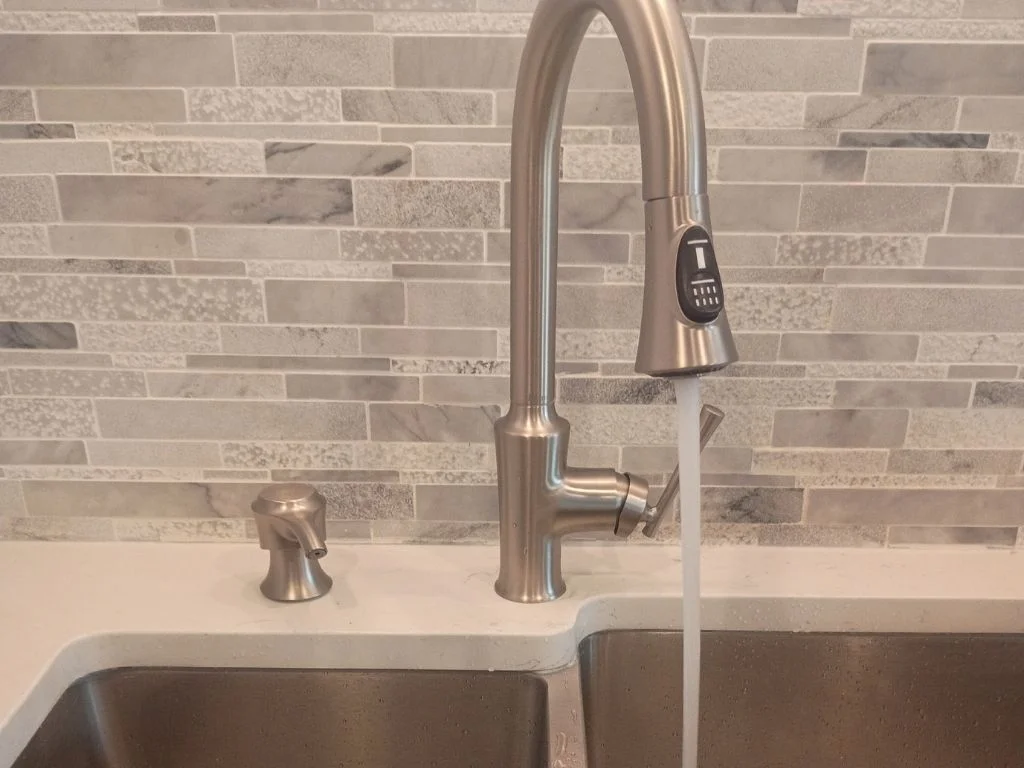
When I find either one, the faucet is a real fix for a real problem, and it is also the smallest part of what is going on. A new fixture on a failing supply pipe buys you a nicer handle. A whole-home repipe in PEX or copper is the work that actually resolves it, and it is what Positively Plumbing LLC specializes in.
I’m not going to push you into that conversation during a faucet call. I will show you what I found, explain what I am seeing, and let you decide when to deal with it. Plenty of homeowners live with a known issue for a year or two and plan the repipe on their own schedule. That is a completely reasonable way to handle it.
Frequently Asked Questions
How Long Does a Kitchen Faucet Installation Take?
About an hour for a straightforward swap where the valves work and the cabinet is accessible. Corroded mounting hardware, seized shutoffs, or a tight undermount configuration can push it to two or three.
Should the Shutoff Valves Be Replaced at the Same Time?
Only if they need it, and in older Largo homes they often do. A valve that closes completely and holds pressure can stay. One that weeps, resists turning, or refuses to close fully gets replaced while the water is already shut off, which costs less than a separate trip later.
Can I Buy My Own Faucet and Have You Install It?
Yes, and many homeowners do. Send me the model number first so I can confirm it matches your hole configuration, your counter thickness, and the space in your cabinet. Checking that at the store is easier than discovering it with the old faucet already out.
Why Does My Aerator Keep Clogging?
Largo’s water hardness. Mineral deposits collect in the aerator screen faster here than in softer-water regions. Unscrew the tip every three to six months and soak it in white vinegar overnight, and it will clear right up.
Does a New Faucet Fix Low Water Pressure?
Sometimes. If the pressure drop is at that one fixture, a clogged aerator or cartridge is the usual cause, and a new faucet solves it. If pressure is low throughout the house, the answer is in the supply piping, and that is worth looking at properly.
Talk to Someone Who Will Look First
Positively Plumbing LLC is family-owned and based right here in Largo, serving Clearwater, Seminole, St. Petersburg, and the rest of Pinellas County. My background is in custom home construction, which is a large part of why I look at the whole system under your sink alongside the fixture on top of it.
Tell me what you are seeing, and I’ll give you a straight answer about what it needs, including the times when the answer is simpler and cheaper than you expected. Reach out at (727) 625-0603 for a free estimate, and we will get your kitchen sorted.
