

Water Heater Relief Valve Replacement: Signs, Steps, and Florida Code Rules
Water dripping near the water heater usually traces back to the temperature and pressure relief valve. This T&P valve opens on its own when tank water passes roughly 210 degrees Fahrenheit or 150 psi, and it gets noticed only once it weeps, sticks shut, or crusts over with scale. A drip is often a symptom of high supply pressure or thermal expansion, so a new valve installed without that diagnosis starts weeping again within weeks.
I’m Stephanie Byrne, co-owner of Positively Plumbing right here in Largo. This guide comes straight from the hands-on water heater work our family-owned team does every day across Pinellas County.
The sections below cover the warning signs, the replacement steps, the discharge piping rules Florida enforces, and how to tell whether the valve is the problem or the messenger. Hard water speeds up valve failure here, so you can also read how Largo’s hard water affects your plumbing, or review our water heater services in Largo.
What a Water Heater Relief Valve Does
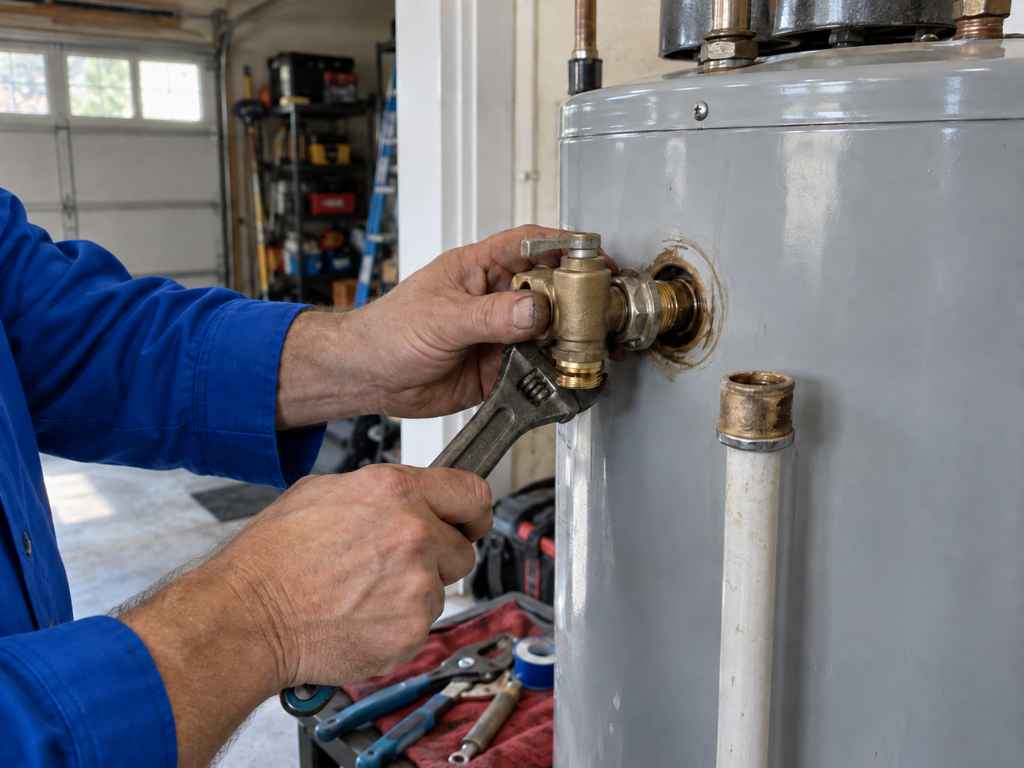
The T&P valve is a brass body with a spring-loaded seat, a temperature probe that extends into the tank, and a test lever on top. It stays closed through normal operation. Once tank temperature or pressure reaches the stamped rating, the seat lifts and water discharges through a pipe that carries it safely down toward the floor or an approved receptor.
It is a mechanical part with a finite service life. Scale collects on the seat, the spring loses tension, and the valve eventually does one of two things: weeps continuously, or stays shut when it should open. The first one is visible. The second one is silent, which is why manufacturers build a test lever into every valve.
Signs a T&P Valve Needs Replacing
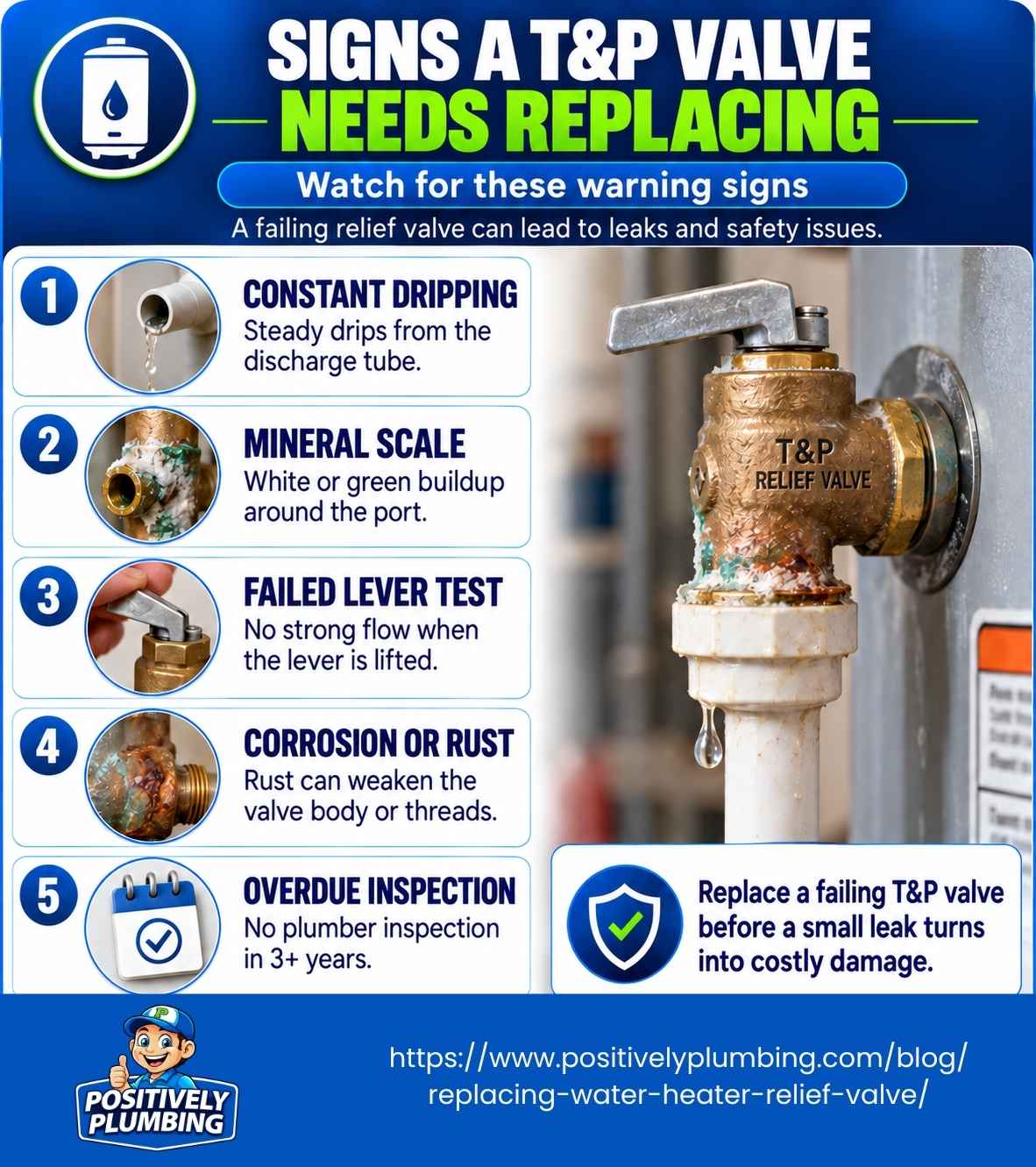
- Constant weeping or dripping. Water trickling from the discharge tube points to a worn seat, debris under the seal, or pressure conditions in the house pushing the valve open.
- Heavy mineral scale at the port. White or greenish crust around the threads means hard water deposits are working their way into the spring mechanism.
- A failed lever test. Lifting the test lever should produce a strong rush of water that stops cleanly when the lever is released. No flow means the valve is blocked. Watts instructs owners to shut the water heater down and call a plumber when that happens.
- Corrosion on the valve body or threads. Visible rust weakens the casting and makes a clean removal harder the longer it sits.
- No professional inspection in the last three years. The Watts warning tag shipped with residential relief valves calls for the owner to operate the lever at least once a year, and for a licensed plumbing contractor to inspect the valve at least every three years and replace it if needed.
A tank showing several of these at once is often telling you something larger. Units past the ten-year mark with a seized valve, rust at the fittings, and rumbling at the burner are usually better candidates for a full replacement, and our comparison of tankless vs. tank heaters for Florida homes covers what that decision looks like.
How the System Is Prepared for Safe Replacement
Every T&P replacement starts with isolation, because the tank holds 40 to 80 gallons of water heated well past scalding temperature.
- Electric units get shut down at the breaker panel, which also protects the upper heating element from dry firing.
- Gas units get the control set to PILOT or the supply valve closed entirely.
- The cold water inlet valve closes, and a hot water faucet inside the house opens to break the vacuum.
- A drain hose pulls one to two gallons off the tank so the water level sits below the valve port.
From there, it is a short parts list: a pipe wrench sized to the valve body, hot-water-rated PTFE tape, a pipe joint compound rated for potable hot water, and a replacement valve matched to the heater’s BTU input and pressure rating. Homeowners who want the rest of the system checked during the same visit can add it to a standard plumbing repairs appointment.
How the Replacement Is Performed
- Discharge line removal. The rigid copper or CPVC discharge pipe comes off the old valve without stressing the surrounding fittings.
- Valve extraction. The old 3/4-inch threaded valve body backs out with controlled leverage, keeping stress off the glass lining inside the tank.
- Thread cleaning. The tank opening gets brushed free of old sealant, rust flakes, and mineral scale so the new valve seats on clean threads.
- Thread preparation. Four to six clockwise wraps of hot-water-rated tape go on the male threads of the new valve, topped with a compatible pipe joint compound.
- Installation. The valve threads in by hand first to avoid cross-threading, then tightens with controlled wrench turns to a leak-free seal without over-torquing the casting.
- Discharge line reconnection. The pipe goes back on with a continuous downward slope and a terminus that meets code.
Discharge Piping Rules Florida Enforces
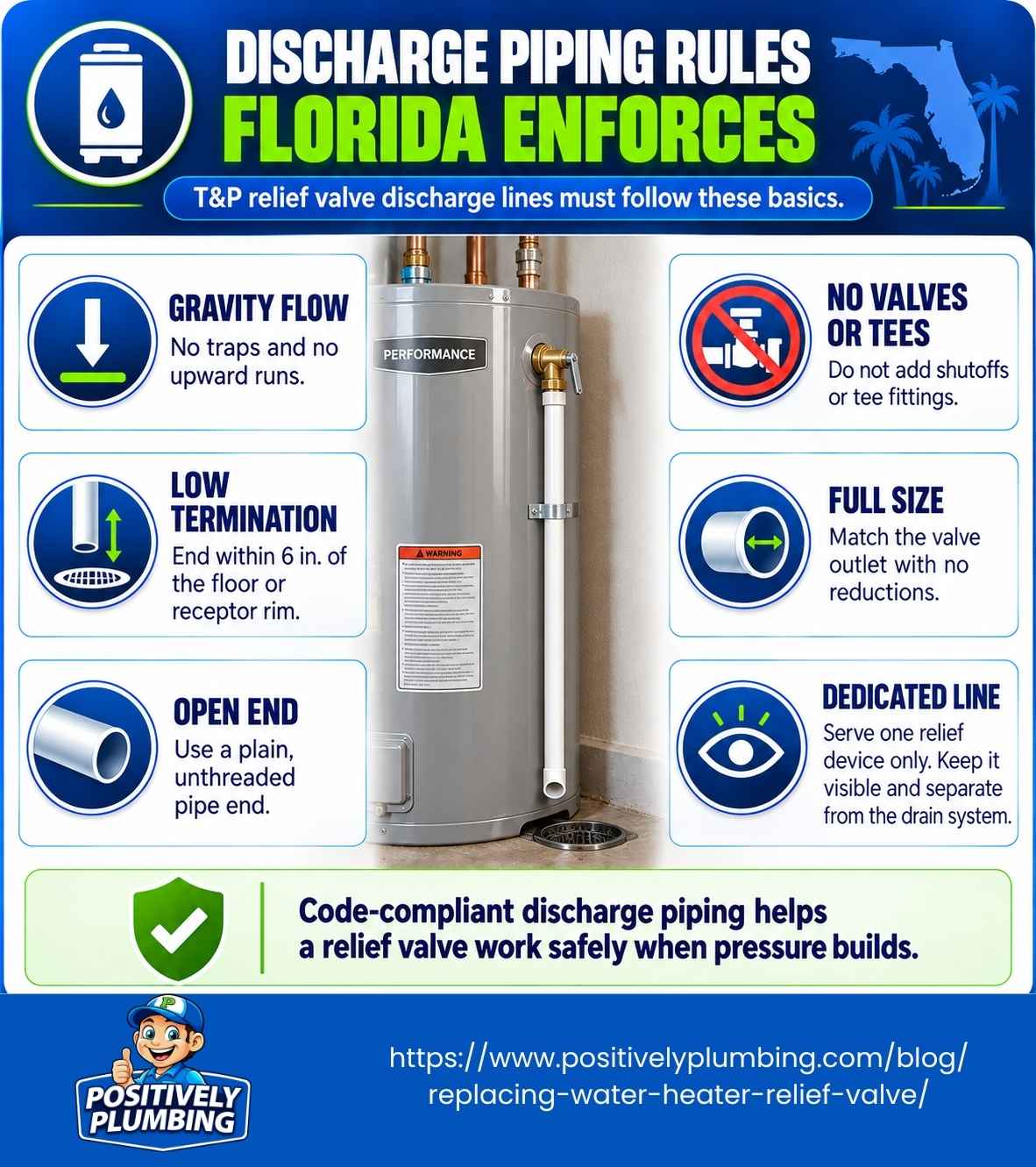
The discharge line is where most homeowner installations go wrong, and it is a straightforward list. Section 504.6 of the Florida Building Code, Plumbing, requires that relief valve discharge piping:
- Flow by gravity with no traps and no upward runs.
- Terminate no more than 6 inches above the floor or the flood level rim of the receptor, and no less than two pipe diameters above it.
- End in plain, unthreaded pipe with no valves or tee fittings anywhere in the run.
- Stay full size, matching the valve outlet, with no reducing couplings.
- Serve that single relief device and connect to nothing else.
- Stay visible to the people living in the building, and never tie directly into the drainage system.
Manufacturer instructions add practical limits on top of the code. Runs longer than 30 feet or more than four elbows restrict flow enough to cut the valve’s discharge capacity. A full water heater replacement needs a permit in Largo, and a like-for-like changeout is issued over the counter with no plan review. Whether a valve-only swap needs one is a question for the Largo Building Division, and we handle that call as part of the job. The City of Largo permits page lays out how mechanical and plumbing changeouts are handled locally.
Testing and Verification After Installation
Refilling comes next. The main supply reopens slowly with an interior hot faucet held open until the trapped air is out and the stream runs steady. Power or gas comes back on after that, never before, and the lever test confirms two things: water discharges freely, and the seat closes tight when the lever releases.
A brand new valve that keeps weeping is pointing somewhere else. Supply pressure over 80 psi calls for a pressure-reducing valve. A closed-loop system with a backflow preventer or check valve calls for a thermal expansion tank. Heavy scale on a valve that is only a few years old points at water chemistry, which a whole-home water softener addresses at the source.
Capping or plugging a dripping relief valve removes the tank’s pressure release entirely, and no licensed plumber will leave a system that way. Active leaking, no hot water, or a pressure spike after the work is done is worth a same-day call to our emergency plumbing team.
Why a Relief Valve Gets Replaced Rather Than Rebuilt
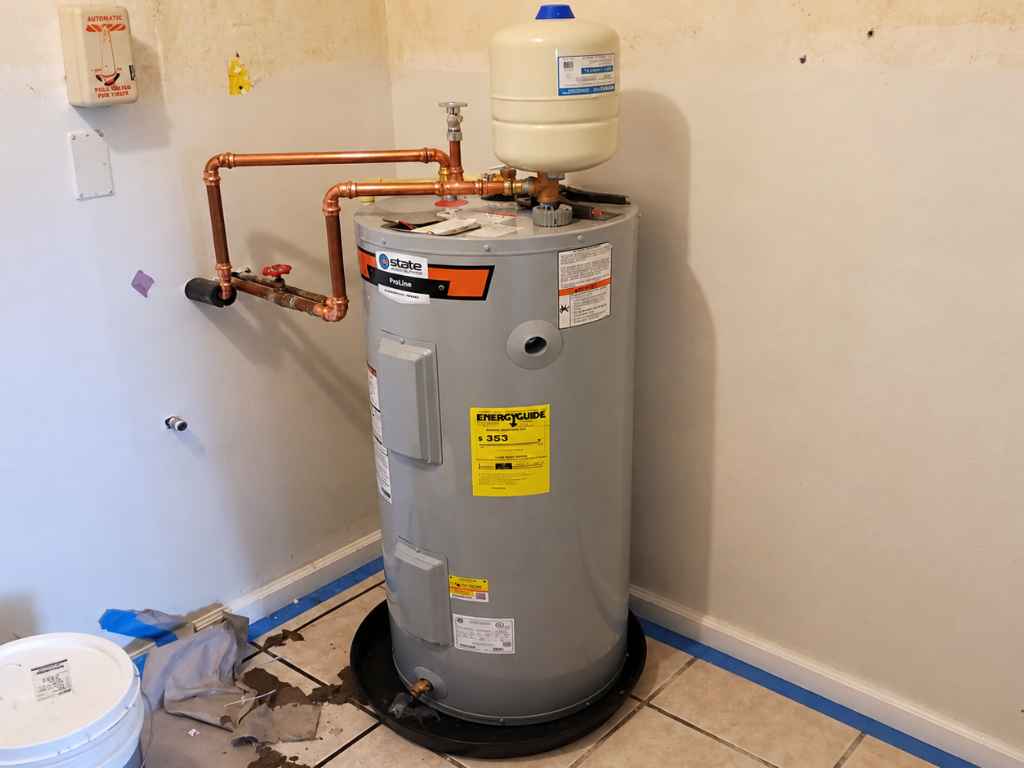
Homeowners ask whether a dripping T&P valve can be cleaned, tightened, or adjusted back into service. The answer is no, and it comes straight from the manufacturer. The warning tag on a residential Watts relief valve states plainly that repair or alteration of the valve by anyone is prohibited by national safety standards and local codes.
The reason is calibration. The valve leaves the factory set to open at a specific temperature and pressure, and that setting depends on spring tension and a precise metal-to-metal seal. Lapping the seat or adjusting the spring changes the opening point in ways nobody can verify in a garage. Replacement with a valve matched to the heater’s BTU input, shank length, and pressure rating restores a known, certified set point.
Why the Cheap Part Turns Into an Expensive Repair
Replacement valves sell for $20 to $45 at hardware stores, which is what tempts homeowners into a Saturday attempt. The hidden costs sit in what goes wrong. Corroded brass threads seize inside aging tank spuds. Force applied without stabilizing the tank can crack the glass lining or twist the cold-water dip tube, which turns a small part into a full replacement.
| Service Option | Estimated Initial Cost | Potential Downstream Risk / Cost |
|---|---|---|
| Professional Valve Replacement | Within our standard water heater repair range of roughly $120 to $700 depending on what the diagnosis turns up | Correct valve rating, code compliant discharge line, and a diagnosis of the underlying pressure condition |
| DIY Valve Replacement | $20 to $45 in parts | Thread damage, tank lining risk, and a discharge line that may not meet code |
| Leaving a dripping valve in place | $0 today | Ongoing water contact with slab, drywall, or subfloor, and a safety device of unknown condition |
Key Takeaways
- A T&P valve that weeps, sticks, or carries heavy scale has stopped being a reliable safety device and needs replacement rather than a cleaning.
- Operate the test lever once a year, and have a licensed plumbing contractor inspect the valve at least every three years, per manufacturer instructions.
- Discharge piping has specific Florida code requirements: gravity flow, full size, unthreaded terminus, and a stop no more than 6 inches above the floor.
- A new valve that keeps dripping is reporting high supply pressure or thermal expansion, and the fix is a pressure-reducing valve or an expansion tank.
- Capping a dripping relief valve removes the tank’s pressure release and should never be used as a temporary fix.
Get the Valve Checked by a Licensed Plumber
A relief valve is a small part with a large job, and it takes a short visit to confirm whether yours is doing it. Positively Plumbing serves homeowners across Largo, Clearwater, St. Petersburg, Seminole, Pinellas Park, and surrounding Pinellas County communities with licensed work, written pricing before anything starts, and a straight answer on whether the valve or the system is the real problem.
Schedule service online or call (727) 625-0603. Honest work. Clear answers. Positively Plumbing.
